
Uncategorized
Designer Benzofurans Explained: The 5-EAPB, 5-MAPB & 6-APB Identification Catalog (2026)
Sep
Designer Benzofurans Explained:
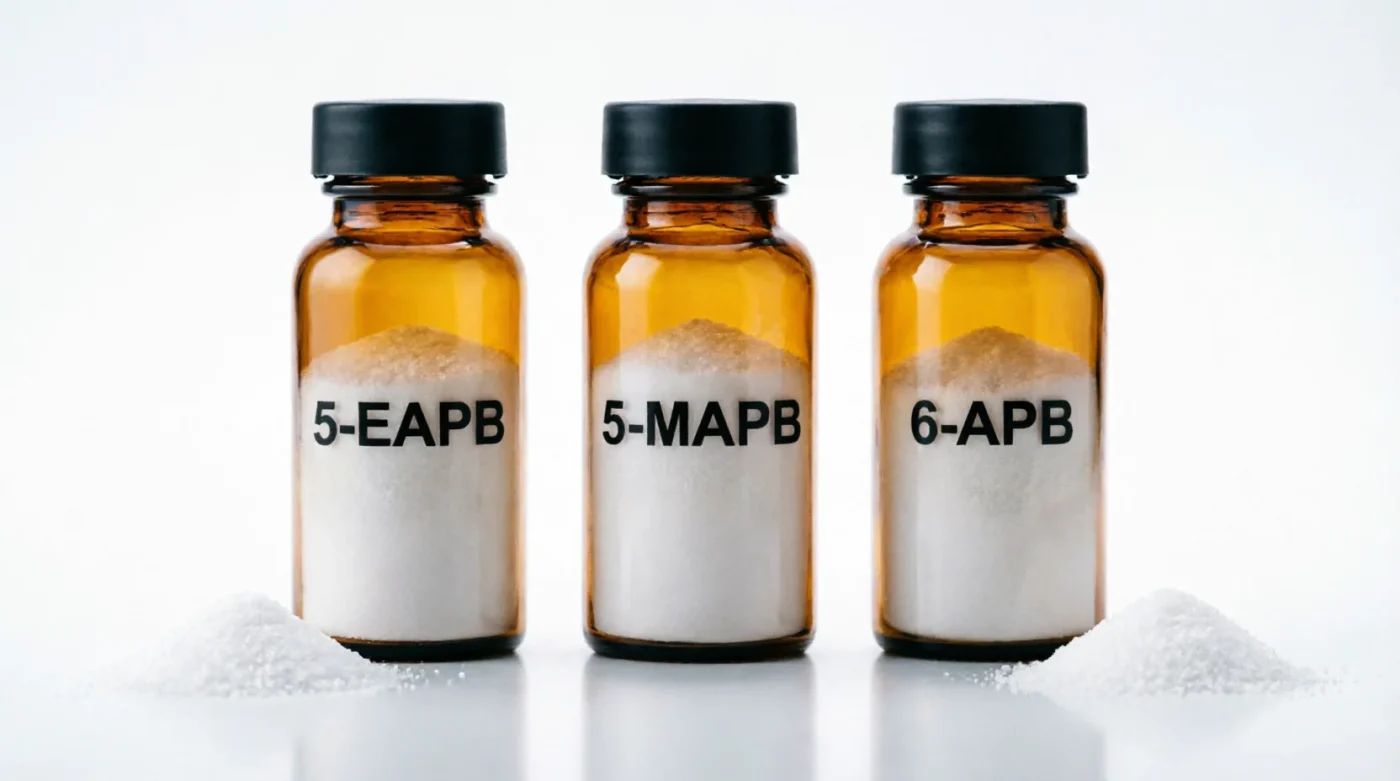
Designer benzofurans are aminoalkylbenzofuran analogs — the benzofuran ring rebuilt with positional and N-alkyl substitutions that never passed pharmaceutical registration — and they move through seizure streams faster than scheduling tables update. This designer benzofurans catalog maps the three families that dominate 2026 casework — 5-EAPB, 5-MAPB and 6-APB — plus every pressed and salt format they circulate in, and ties each family to the exact-mass targets, retention behaviour and verification documents laboratories actually need.
Unlike chemistry-supplier pages that treat “benzofuran” as a scaffold catalogue, this designer benzofurans guide is built for identification work: every entry carries ring position, N-substituent, exact mass and format geometry, and every family interlinks its live reference units so a library can be built directly from the page.
One Ring, Three Intents: Where This Catalog Fits
Search engines treat the head term “benzofuran” as a chemistry query — its results are dominated by industrial scaffold suppliers — which is why our class-level benzofuran blog owns context while this designer benzofurans catalog owns enumeration and identification. Readers seeking ring chemistry and class pharmacology should start with our benzofuran class overview; readers who need to assign a peak, verify a pellet or vet a vendor belong here.
The entity lineage matters for authority: forensic literature classifies these compounds as aminoalkylbenzofuran derivatives, a family distinct from the methylenedioxyphenyl entactogens despite overlapping search behaviour. Registry records in PubChem document each scaffold independently, and every entry in this designer benzofurans catalog is mirrored against those records before publication.
Reading the Family: Ring-Position × N-Alkyl Ladder
Every entry on the designer benzofurans ladder sits at the intersection of two axes: ring position (5- versus 6-substitution) and N-alkyl substitution (primary amine, N-methyl or N-ethyl). Those two variables predict retention order, fragment ratios and metabolite pathways more reliably than any street name, which is why this catalog is ordered by ladder rather than alphabetically.
| Compound | Ring position | N-substituent | Formula / MW | Live formats |
|---|---|---|---|---|
| 6-APB | 6 | Primary amine | C11H13NO / 175.23 | Succinate powder, 130 mg & 100 mg pellets |
| 5-MAPB | 5 | N-methyl | C12H15NO / 189.25 | Powder, pellets, blend component |
| 5-EAPB | 5 | N-ethyl | C13H17NO / 203.28 | Powder, pellets, blend component |

Substance identities and salt forms are cross-checked against the FDA GINAS substance registry so that internal codes, CAS numbers and registry UUIDs reconcile across procurement, LIMS and casework files. A designer benzofurans library built ladder-first avoids the single-compound blind spot that causes cross-family misassignment: stock one rung and you can only confirm one rung.
The 6-APB Block: Succinate Powder, 130 mg & 100 mg “Benzo Fury” Pellets
6-APB is the primary-amine, 6-substituted rung — and the most-queried block in the entire designer benzofurans space, carrying both the registry name and the street alias “benzo fury.” The alias is the block’s central forensic problem: listings and exhibits labelled benzo fury have repeatedly resolved to 5-APB, 6-APDB or mixed benzofuran content, so the alias confirms nothing without instrumentation.
Format coverage is the block’s strength: 6-APB Succinate supplies the 1:1 salt for gravimetric stock solutions with a fixed 0.597 freebase conversion factor, while 6-APB 130mg Pellets deliver the heaviest pressed geometry in our benzofuran line for repeatable curve points and unit-mass audits. Each format in this designer benzofurans block ships with identical lot documentation — quality is never tiered by geometry.
The alias-decoding rung is Benzo Fury 6-APB 100mg Pellets: pressed units whose certificate reconciles the street name to registry-verified 6-APB by exact mass and ring-position retention. For collectors and screening desks searching the alias rather than the registry name, this is the only designer benzofurans entry that closes that loop on paper before instrumentation begins.
Uniformity discipline runs through the whole block: pressed units are audited for mass (RSD below two percent), score-line depth and hardness before sealing, and succinate jars carry counterion titration data. A designer benzofurans library that stocks both the salt and the pressed geometry can run gravimetric checks, calibration curves and alias reconciliation from one lot number — the defensible configuration for any designer benzofurans reference shelf.
The 5-MAPB Block: N-Methyl Workhorse
What is 5-MAPB? It is the N-methyl, 5-substituted rung of the ladder — the benzofuran analog most frequently conflated with its 6-position isobar and with the N-ethyl extension below it. Within this designer benzofurans catalog, 5-MAPB is the workhorse: the rung most often requested for method development because its fragment ladder sits cleanly between the primary amine and the N-ethyl analog.
The live reference is stocked as 5-MAPB (benzofuran) powder with full registry documentation (CAS 1354631-77-8, C12H15NO, 189.25 g/mol). Format queries in this designer benzofurans block — milligram-strength variants and pressed-unit requests — resolve to the same certificate chain; geometry changes handling, never identity.
Detection-window queries (“how long does it last” style searches) map to metabolite chemistry, not use guidance: ring-hydroxy and N-demethylated derivatives are the defensible urine markers, and parent compound alone clears blood within hours. Confirmation methods built from this designer benzofurans block should therefore stock metabolite references alongside the parent and state which marker supported each identification.
5-MAPB also anchors the multi-analyte bridge discussed below: it is the benzofuran component of our tri-class blend, which makes the single-rung reference and the blend reference mutually validating. Any designer benzofurans library serving screening desks — rather than pure scaffold chemistry — should hold both, because blend casework is where single-rung libraries fail first, and a designer benzofurans shelf without the blend rung cannot confirm its own most common exhibit.
The 5-EAPB Block: N-Ethyl Extension
5-EAPB closes the core ladder: the N-ethyl, 5-substituted rung, sitting exactly one CH2 unit (14 Da) above 5-MAPB and two above the primary amine. In this designer benzofurans catalog it is the extension rung — lower query volume, but disproportionately important for ladder completeness because it is the rung most often mis-sold as 5-MAPB.
The verified reference is stocked as 5-EAPB (Benzofuran) with registry-matched documentation. Commercial queries in this designer benzofurans block terminate at the same question as every other rung: whose certificate survives audit — answered in the verification section below.
Comparison queries (“5-EAPB versus 5-MAPB”) resolve on the mass axis first: the 14 Da gap separates them at unit resolution, but fragment-ratio comparison against verified injections is what makes the assignment defensible in report language. Review- and duration-style queries in this designer benzofurans block are treated as OSINT intelligence about mislabel risk, never as guidance — a distinction this catalog maintains across every rung.
MaXTC: The Multi-Analyte Bridge
MaXTC is the catalog’s bridge product: a ratio-declared tri-class blend pressing the benzofuran rung (5-MAPB) alongside a fluorinated amphetamine and a methoxytryptamine at declared per-pellet loads. Within this designer benzofurans catalog it matters for one reason — blend exhibits are the fastest-growing casework category, and a library without a blend reference cannot deconvolute them.
The live unit is MaXTC 5-MAPB / 4-FMA / 5-MeO-MiPT, released only after a ten-pellet strip audit holds the declared ratio within five percent RSD per component. That audit is what elevates a blend from recipe to measurement, and it is the standard this designer benzofurans catalog applies to every multi-analyte entry.
When to choose blend versus single rung? Single rungs for scaffold confirmation and calibration; the blend for screening-desk realism and deconvolution validation. A complete designer benzofurans shelf holds both configurations under matched lot logic.
The Isobaric Trap: 5- vs 6-Position Cannot Be Assigned by Mass Alone
Here is the failure mode most vendors never mention: 5- and 6-substituted benzofuran analogs share one formula and one exact mass — 175.0997 for the APB pair — so their protonated ions land on the same nominal m/z. Mass spectrometry alone cannot assign ring position, which means any designer benzofurans identification resting on nominal mass is an assumption, not a result.
The defensible workflow is co-injection: spiking the exhibit with a verified 6-position reference fixes the 6-rung retention window on your column, and the 5-position analog resolves as a separate peak. Fragment libraries cross-checked against the NIST Chemistry WebBook support the assignment, but the physical reference is what makes it court-ready — the single strongest argument for ladder-complete designer benzofurans stocking.
Fragment-ratio comparison provides the second axis: 5- and 6-substituted analogs produce distinguishable ion-ratio signatures at qualified transitions, and those ratios — not peak presence — carry the identification in report language. Every designer benzofurans certificate we publish lists both retention and ratio data for exactly this reason, and any designer benzofurans vendor unable to supply both is selling spectra, not identifications.
Analytical Workflow: MRM Targets & Metabolite Markers
Release and confirmation methods for this designer benzofurans family run on LC-MS/MS in positive ESI: two qualified transitions per rung, ion-ratio windows, and a matrix-matched calibration curve per geometry. Powder, pellet and blend extracts are never interchangeable calibration sources, so geometry is stated on every report line.
Metabolite standards travel with the parent: ring-hydroxy, N-demethylated and oxidative markers are the defensible urine targets, and international listing status for each rung is mirrored against UNODC records so jurisdiction notes move with the chemistry. A designer benzofurans method library without metabolite rungs confirms intake poorly and expires quickly.
GC-MS remains viable for powder exhibit triage but tolerates thermal artefacts on the furan ring; the designer benzofurans workflow therefore reserves GC-MS for screening and commits confirmation to LC-MS/MS. Libraries that invert that order publish fragile identifications, and fragile identifications are why this designer benzofurans catalog states its workflow publicly.
Legal Landscape 2026: Scheduling by Region
Legality queries — including “is 5 mapb legal in us” style searches — resolve to a patchwork, not a single answer: US federal analog-act exposure combines with state-level scheduling, while international review cycles at the WHO Expert Committee drive national cascades. Every rung in this designer benzofurans catalog carries a review date for that reason.
EU member states enforce uneven NPS bans documented in EUDA alert streams; Australia’s Poisons Standard and UK psychoactive-substances legislation capture most of the ladder outright. Procurement desks should re-verify jurisdiction status before each purchase order — a designer benzofurans list without jurisdiction notes is a liability map, not a reference.
Because status moves quarterly, this designer benzofurans catalog is re-audited against WHO, UNODC and EUDA streams on a fixed cycle, and every product page inherits the current status table at publish time.
Procurement Verification: Where Can I Buy 6-APB With a Real COA
Commercial queries — where can I buy 6-APB, buy 5-EAPB online, benzo fury for sale — all terminate at one question: which vendor’s documentation survives audit? The designer benzofurans vetting protocol requires four documents before any order: HPLC purity with impurity listing, NMR identity, HRMS exact mass, and lot traceability.
Every unit linked from this designer benzofurans catalog ships with that four-document pack sealed with the lot; quotes and multi-unit schedules run through the benzofuran category or customer support, and bulk allocations carry identical paperwork to single units.
Supplier-comparison honesty is part of the protocol: if your target is a single scaffold at pressed geometry, the 130 mg rung outperforms the blend; if your exhibit stream is blend-heavy, the single rung alone will fail you. Run any designer benzofurans supplier comparison you like, then ask for the batch record — ours arrives automatically, and any designer benzofurans vendor who hesitates on that request has answered the comparison for you.
OSINT Market Monitoring
Forum streams — Reddit r/researchchemicals, Bluelight, Erowid and PsychonautWiki — surface mislabel and substitution alerts weeks before formal publication, particularly in the benzo-fury alias stream. The designer benzofurans maintenance loop monitors those threads as intelligence triggers for re-verification, never as guidance.
When a thread flags a batch sold under the wrong rung, the response is analytical: re-run the affected lot’s retention and ratio data against the ladder references. That loop is why this designer benzofurans catalog’s certificates carry lot-level retention data rather than generic spectra.
Frequently Asked Questions
What are designer benzofurans versus the benzofuran ring in chemistry?
The ring is an industrial scaffold; designer benzofurans are its aminoalkyl analogs — 5-EAPB, 5-MAPB, 6-APB and relatives — catalogued here for identification and reference purposes, not scaffold commerce.
What is 5-MAPB?
The N-methyl, 5-substituted rung of the ladder (C12H15NO, 189.25 g/mol); this designer benzofurans catalog stocks it as powder with full registry documentation.
Is 5-MAPB legal in the US?
Status is a patchwork of federal analog-act exposure and state schedules; verify current jurisdiction notes before ordering any rung.
What does “benzo fury” actually refer to?
A street alias for 6-APB — but alias-labelled material has resolved to 5-APB, 6-APDB and mixtures, so only instrumentation confirms it.
5-EAPB vs 5-MAPB — what separates them analytically?
A 14 Da N-alkyl gap at unit resolution, then fragment-ratio comparison against verified injections for the defensible assignment.
How long does 5-MAPB remain detectable in urine?
Parent clears blood within hours; ring-hydroxy and N-demethylated metabolites extend urine detection, which is why metabolite standards accompany every rung.
6-APB succinate powder vs pressed pellets — which format for reference work?
Powder for gravimetric stocks with the 0.597 conversion factor; pellets for repeatable curve points and unit-mass audits. Many libraries stock both.
Does 6-APB cross-react on standard benzo immunoassays?
Unpredictably at best; benzodiazepine immunoassays are not benzofuran screens — confirmation requires LC-MS/MS against a verified rung.
Where can I buy 6-APB with a verifiable COA?
From vendors publishing the four-document pack per lot; every unit linked from this designer benzofurans catalog ships with HPLC, NMR, HRMS and lot traceability.
How is 5- vs 6-ring position confirmed when masses are identical?
By co-injection retention locking and fragment-ratio comparison — nominal mass alone cannot assign ring position.
Conclusion: Build the Ladder, Not the Compound
A single-rung library confirms one compound; a ladder confirms a family. This designer benzofurans catalog interlinks every live reference unit — succinate powder, pressed pellets, alias-reconciled blisters and the tri-class blend — so identification, procurement and verification sit in one audited place. Bookmark it, re-verify jurisdiction status before each order, and pair it with our class overview and methods guides. The designer benzofurans catalog ends where your validation begins; explore the full cluster on our forensic methodology blog.