
Uncategorized
Ketamine, 2-FDCK & 3-MeO-PCP: 7 Arylcyclohexylamine GC-MS Profiling Methods (2026)
Aug
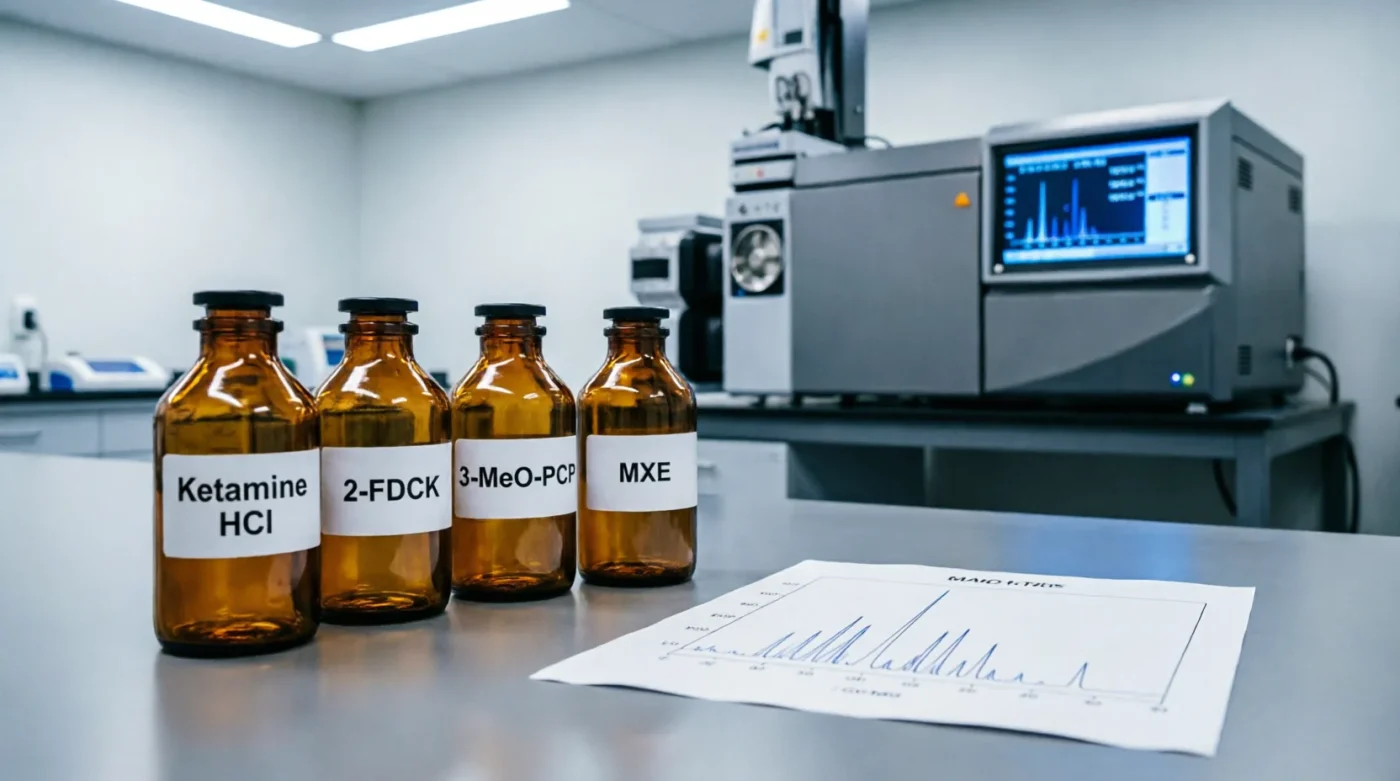
Ketamine, 2-FDCK & 3-MeO-PCP
The analytical characterization of novel dissociative substances has become one of the most technically demanding frontiers in modern forensic toxicology. At the center of this evolving analytical landscape sits ketamine—the prototypical arylcyclohexylamine that has generated an entire lineage of designer analogs. When analytical chemists discuss the parent compound, they are referring not just to a single pharmaceutical, but to a vast structural scaffold that includes arylcyclohexylamines such as 2-FDCK, 3-MeO-PCP, MXE (methoxetamine), and deschloroketamine. For forensic laboratories, independent researchers, and analytical toxicologists, mastering the GC-MS fragmentation cascades of ketamine and its analogs is essential for defensible casework, accurate toxicological screening, and the continuous calibration of modern mass spectrometers.
This comprehensive analytical dossier delves deep into the structural complexities of the arylcyclohexylamine class. We will explore 7 advanced GC-MS and LC-MS/MS methodologies, dissect the NMDA receptor pharmacology that defines the prototype, examine metabolite mapping for the parent drug and its novel analogs, and outline precise protocols for distinguishing between them. By mastering these approaches, researchers can build robust, interference-free spectral libraries capable of resolving the most challenging dissociative mixtures encountered in modern forensic screening.
The Arylcyclohexylamine Scaffold and NMDA Receptor Pharmacology
To accurately profile these compounds, one must first understand the structural variables that define the drug class. Arylcyclohexylamines are characterized by a cyclohexylamine core bonded to an aryl (typically phenyl) group and an amine substituent. This structural family is the foundation for compounds like ketamine, phencyclidine (PCP), methoxetamine (MXE), 3-MeO-PCP, and the newer 2-FDCK.
Understanding the Pharmacological Classification
A frequent question in both clinical and forensic contexts is what type of drug ketamine is. Unlike classical psychedelics that act primarily at the 5-HT₂A receptor, or opioids that activate the μ-opioid receptor, this compound functions primarily as an uncompetitive antagonist at the N-methyl-D-aspartate (NMDA) glutamate receptor. This pharmacological profile is why the drug is classified as a dissociative anesthetic rather than a classical hallucinogen. However, the mechanism of action extends far beyond NMDA blockade—the molecule also interacts with opioid receptors, monoamine transporters, HCN1 channels, and the mTOR signaling pathway, which explains its rapid-acting antidepressant effects in ketamine therapy.
When researchers ask whether the compound is a psychedelic, the technical answer is nuanced: it produces dissociative states that overlap with psychedelic phenomenology, but its primary pharmacology is NMDA antagonism. Similarly, when asking whether it is an opioid, the answer is that the molecule does bind to μ-opioid receptors with modest affinity, though this contribution to its clinical effects remains debated. This pharmacological complexity is precisely why clinical dissociative therapy for treatment-resistant depression has become one of the most actively researched areas in modern psychiatry.
The Pharmacological Effects Profile
The pharmacological effects profile spans a continuum from sub-anesthetic dissociation to full surgical anesthesia. At low doses (0.1-0.5 mg/kg), ketamine produces mild dissociation, analgesia, and mood elevation—the basis for clinical therapy and the growing interest in microdosing protocols. At moderate doses (0.5-1.5 mg/kg), it produces pronounced dissociation, visual distortions, and analgesia. At high doses (>2 mg/kg), it induces complete dissociative anesthesia.
The adverse side effects profile includes transient emergence reactions (confusion, agitation, vivid dreams), nausea, increased heart rate and blood pressure, and at very high chronic doses, urinary tract pathology (cystitis). In forensic contexts, understanding these pharmacological effects helps toxicologists interpret blood and urine concentrations in post-mortem cases and suspected driving-under-the-influence investigations.

“The adverse side effects profile includes transient emergence reactions (confusion, agitation, vivid dreams), nausea, increased heart rate and blood pressure, and at very high chronic doses, urinary tract pathology (cystitis). In forensic contexts, understanding these pharmacological effects helps toxicologists interpret blood and urine concentrations in post-mortem cases and suspected driving-under-the-influence investigations.”
GC-MS Fragmentation Cascades: Decoding the Parent Compound and Its Analogs
Gas Chromatography-Mass Spectrometry (GC-MS) remains the gold standard for the volatilization, separation, and archival identification of ketamine and its arylcyclohexylamine analogs. The EI (electron impact) mass spectrum of ketamine is one of the most recognizable fragmentation cascades in forensic mass spectrometry.
The Mass Spectrum: Diagnostic Ions
The EI mass spectrum of ketamine hydrochloride (free base M+• m/z 237) exhibits several diagnostic fragment ions:
- m/z 237 — Molecular ion (M+•), typically visible at ~5% relative abundance
- m/z 219 — Loss of H₂O from the molecular ion
- m/z 180 — Base peak resulting from alpha-cleavage with loss of the methylamine fragment
- m/z 152 — Sequential loss of CO from m/z 180
- m/z 125 — Loss of HCN from m/z 152, diagnostic for arylcyclohexylamines
- m/z 91 — Tropylium cation, common across many aryl compounds
- m/z 58 — Methyl-iminium ion (CH₃-N=CH₂+), highly diagnostic for N-methylated amines
When analyzing ketamine hydrochloride directly without derivatization, the polar HCl can cause thermal degradation in the GC inlet. Converting the salt to its free base prior to analysis, or using chemical derivatization with trifluoroacetic anhydride (TFAA), significantly improves peak shape and sensitivity.
Differentiating the Parent Compound from Structurally Similar Analogs
One of the greatest challenges in arylcyclohexylamine analysis is distinguishing between compounds that share similar fragmentation cascades. For instance, ketamine powder and deschloroketamine (DCK) share many diagnostic ions, but DCK’s molecular ion appears at m/z 203 (vs. m/z 237 for the parent drug) due to the absence of the chlorine atom. Similarly, methoxetamine (MXE) produces a molecular ion at m/z 247 with diagnostic ions at m/z 178 and m/z 150, clearly distinguishing it from ketamine.
For laboratories handling ketamine crystals or powdered samples, maintaining a comprehensive spectral library that includes all known analogs is essential. Cross-referencing experimental spectra against authenticated reference standards prevents misidentification, particularly when novel analogs like 2-FDCK begin appearing in seized materials.
“For laboratories handling ketamine crystals or powdered samples, maintaining a comprehensive spectral library that includes all known analogs is essential. Cross-referencing experimental spectra against authenticated reference standards prevents misidentification, particularly when novel analogs like 2-FDCK begin appearing in seized materials.”
2-FDCK, 2-Fluoroketamine, and the Halogen-Substituted Series
The emergence of 2-FDCK (2-fluorodeschloroketamine, also known as 2-fluoroketamine or 2f-dck) represents one of the most analytically significant developments in the arylcyclohexylamine class. When researchers ask what 2-FDCK is, they are referring to a designer compound where the chlorine atom on ketamine‘s phenyl ring has been replaced with fluorine. This seemingly minor modification dramatically alters the compound’s mass spectrometric signature, pharmacokinetics, and metabolic pathway.
The 2-FDCK Mass Spectrometric Fingerprint
The EI mass spectrum of 2-FDCK (M+• m/z 221) is distinct from ketamine in several critical ways. The molecular ion is shifted down by 16 Da relative to ketamine (m/z 237) because fluorine (19 Da) is lighter than chlorine (35 Da). Key diagnostic fragments include:
- m/z 221 — Molecular ion (M+•)
- m/z 203 — Loss of H₂O from molecular ion
- m/z 180 — Alpha-cleavage base peak (same as ketamine)
- m/z 164 — Diagnostic fluorophenyl iminium fragment
- m/z 146 — Loss of HF from m/z 164
- m/z 125 — Classic arylcyclohexylamine fragment
- m/z 58 — Methyl-iminium ion
The presence of the m/z 164 fragment is particularly diagnostic for 2-FDCK. When comparing DCK and 2-FDCK mass spectra, the absence of the m/z 164 fragment in DCK’s spectrum provides immediate identification.
CYP2B6 Halogen Substitution Kinetics
Research has established that halogen substitution in arylcyclohexylamines follows predictable patterns in CYP2B6-mediated metabolism. The docking strength for CYP2B6 follows the pattern: H < Br < Cl < F, while intrinsic hepatic clearance follows: Br > Cl > F > H. This means 2-FDCK is metabolized more slowly than ketamine, resulting in a longer biological half-life and extended pharmacological effect. For laboratories analyzing samples where community discussions suggest recent use, understanding these metabolic kinetics is essential for selecting appropriate detection windows.
Sources of Reference Standards
Because ketamine analogs are increasingly scheduled worldwide, researchers must source verified reference materials from reputable suppliers. Our catalog includes authenticated reference standards for analytical comparison:
- Buy Ketamine Online — Certified reference standard
- Ketamine Powder — High-purity reference material
- Ketamine Crystals — Crystalline reference for XRD validation
- Liquid Ketamine — Pharmaceutical-grade solution
“Because ketamine analogs are increasingly scheduled worldwide, researchers must source verified reference materials from reputable suppliers. Our catalog includes authenticated reference standards for analytical comparison:”
3-MeO-PCP, MXE, and the Methoxylated Arylcyclohexylamines
While ketamine and 2-FDCK dominate forensic casework, the methoxylated arylcyclohexylamines represent another significant sub-class. 3-MeO-PCP (3-methoxyphencyclidine, also abbreviated as 3meopcp, mxpcp, or o-pcp) and methoxetamine (MXE) both contain methoxy substituents that dramatically influence their mass spectrometric profiles.
3-MeO-PCP: The Meta-Methoxy Phencyclidine Analog
3-MeO-PCP (CAS 1155-60-8, M+• m/z 271) is a phencyclidine analog with the methoxy group in the meta position of the phenyl ring. Its EI mass spectrum features diagnostic ions at m/z 254 (loss of •OH), m/z 200 (loss of piperidine), m/z 172, m/z 135 (methoxyphenyl cation), and m/z 84 (piperidinium ion). The m/z 135 ion is highly diagnostic for 3-methoxyphencyclidine and related meta-methoxylated analogs, distinguishing them from their para-methoxy counterparts (4-MeO-PCP).
The primary metabolite of 3-MeO-PCP is 3-meo-2′-oxo-pcp, formed via oxidative dehydrogenation of the piperidine ring. This metabolite is a critical target for forensic urine screening, as the parent compound may be rapidly cleared while the oxo metabolite persists.
Methoxetamine (MXE): The Methoxyethyl Analog
Methoxetamine (MXE, M+• m/z 247) is structurally related to ketamine but features a 3-methoxyphenyl group and an N-ethyl substituent instead of N-methyl. Its mass spectrum shows diagnostic ions at m/z 230 (loss of •NH₂), m/z 178 (base peak, loss of ethylamine), m/z 150, and m/z 135 (3-methoxyphenyl cation). The shift from m/z 180 (ketamine base peak) to m/z 178 (MXE base peak) provides immediate differentiation between these two structurally similar compounds.
MXE’s primary metabolites include normethoxetamine (N-demethylated), hydroxy-MXE, and several glucuronide conjugates. The biological half-life equivalent for MXE is significantly longer, often extending detection windows to 5-7 days in urine.
Metabolite Mapping and Detection Windows
Detecting parent ketamine in biological matrices is often complicated by rapid metabolism. Therefore, metabolite mapping is just as critical as detecting the parent drug.
The Primary Metabolic Pathway
The drug is primarily metabolized by CYP3A4 and CYP2B6 in the liver. The ketamine metabolic pathway proceeds as follows:
- Parent drug → Norketamine (via N-demethylation, CYP3A4/2B6)
- Norketamine → Dehydronorketamine (via dehydrogenation)
- Norketamine → Hydroxynorketamine (via hydroxylation)
- Hydroxynorketamine → Hydroxynorketamine glucuronide (via UGT2B7)
The ketamine half-life is approximately 2.5 hours, while norketamine has a half-life of 8-12 hours. Dehydronorketamine is particularly persistent, with a half-life extending to several days, making it the preferred target for extended detection windows in forensic urine analysis. How long does ketamine last in urine? The parent compound is detectable for 2-4 days, while norketamine and dehydronorketamine can be detected for 7-14 days in chronic users.
Metabolites of Novel Arylcyclohexylamine Analogs
2-FDCK follows a metabolic pathway analogous to ketamine, producing nor-2-FDCK, dehydronor-2-FDCK, and hydroxynor-2-FDCK. The fluorine atom often remains intact during metabolism, providing a valuable analytical handle for metabolite identification via mass spectrometry.
For 3-MeO-PCP and related phencyclidine analogs, oxidative dehydrogenation produces oxo-metabolites (e.g., 3-meo-2′-oxo-pcp) that are often more abundant in urine than the parent compound. Targeting these metabolites dramatically increases detection sensitivity in forensic screening.
Sample Preparation and Extraction Protocols
Proper sample preparation is critical for successful GC-MS and LC-MS/MS analysis of ketamine and its analogs. Biological matrices such as whole blood, urine, oral fluid, and hair contain proteins, lipids, and salts that can cause severe ion suppression in mass spectrometers.
Solid-Phase Extraction (SPE) Optimization
Solid-phase extraction (SPE) is the most widely used sample preparation technique for arylcyclohexylamines in biological matrices. Mixed-mode cation-exchange (MCX) cartridges are particularly effective, as they retain both neutral and basic compounds. The typical SPE protocol involves:
- Conditioning the cartridge with methanol and water
- Loading the biological sample (diluted and pH-adjusted to ~6.0)
- Washing with water and dilute acid to remove interferences
- Eluting with methanol or acetonitrile containing 2% ammonium hydroxide
Optimizing the extraction conditions for specific analogs is essential to maximize recovery and minimize matrix effects. For ketamine and its analogs, MCX cartridges typically achieve recoveries exceeding 85%.
Liquid-Liquid Extraction (LLE) Methods
Liquid-liquid extraction (LLE) remains a viable alternative to SPE, particularly for laboratories with limited resources. Common LLE solvents include methyl tert-butyl ether (MTBE), ethyl acetate, and hexane:ethyl acetate mixtures. These dissociatives are generally highly lipophilic, making them amenable to LLE with non-polar solvents. However, LLE typically provides lower cleanup than SPE, which can lead to increased matrix effects in LC-MS/MS analysis.
Method Validation and Quality Control
Rigorous method validation and ongoing quality control are essential for producing defensible ketamine data in forensic casework. Validation parameters must meet or exceed established guidelines from organizations like the Scientific Working Group for Forensic Toxicology (SWGTOX).
Accuracy, Precision, and Sensitivity Requirements
Method validation must demonstrate both accuracy (trueness) and precision (repeatability and reproducibility). Acceptable accuracy is generally ±15% of the nominal concentration (±20% at the lower limit of quantification). Coefficients of variation (CV) should be ≤15% for acceptable precision.
Establishing the Limit of Detection (LOD) and Limit of Quantification (LOQ) is a critical validation step. For modern LC-MS/MS systems analyzing ketamine in urine, typical LOD values range from 0.5-1.0 ng/mL, and LOQ values range from 1.0-5.0 ng/mL. These low detection limits are essential for detecting trace levels in forensic samples.
Using Certified Reference Materials
The use of certified reference standards is fundamental to reliable analysis. Certified reference materials provide traceability to national standards and ensure the accuracy of quantitative results. For ketamine, 2-FDCK, 3-MeO-PCP, and related analogs, analysts should use reference standards with documented purity (typically ≥98%) and a Certificate of Analysis (CoA) from a reputable supplier.
Our catalog includes authenticated reference standards for the entire arylcyclohexylamine class:
- 3-MeO-PCP Analytical Standard — Certified 3-methoxyphencyclidine
- 3-HO-PCP Reference Material — Hydroxylated phencyclidine analog
- 4-MeO-PCP Standard — Para-methoxy phencyclidine analog
- Methoxetamine (MXE) — Methoxylated analog
“For ketamine, 2-FDCK, 3-MeO-PCP, and related analogs, analysts should use reference standards with documented purity (typically ≥98%) and a Certificate of Analysis (CoA) from a reputable supplier.
Street Names, Adulteration, and Reagent Testing
Street ketamine samples are frequently adulterated with other dissociatives, stimulants, or cutting agents. Understanding common street aliases and reagent testing responses helps forensic laboratories develop comprehensive screening panels.
Common Street Aliases
When researchers ask about common ketamine street names, the most frequent aliases include:
- Special K — The most widely recognized alias
- K — Abbreviated form frequently used in online communities
- Cat Valium — Reference to its veterinary use
- Ket, Keta — Common shorthand forms
- Horse Tranquilizer — Popular media characterization
- Vitamin K — Misleading slang term
- Jet, Super Acid — Less common aliases
When comparing seized samples, analysts must account for the wide variability in purity and adulteration. Street materials are often cut with caffeine, lidocaine, benzocaine, or other dissociatives like 2-FDCK or MXE. Comprehensive ketamine screening must include panels targeting these common adulterants.
Reagent Testing Responses
Colorimetric reagent testing provides rapid preliminary identification:
- Marquis Reagent: Typically produces no color change or a faint orange/yellow
- Mandelin Reagent: Produces orange/yellow color
- Liebermann Reagent: Produces yellow to orange color
- Froehde Reagent: Produces yellow-orange color
However, reagent testing alone is insufficient for definitive identification of ketamine. Novel analogs like 2-FDCK and MXE may produce similar or identical reagent responses. Definitive identification requires instrumental analysis via GC-MS or LC-MS/MS.
Frequently Asked Questions (FAQ)
Q1: What is ketamine and how does it work?
A: It is a dissociative anesthetic that acts primarily as an uncompetitive antagonist at the NMDA glutamate receptor. At a molecular level, it blocks the NMDA receptor channel, preventing calcium influx and disrupting glutamatergic signaling. This mechanism produces the characteristic dissociative state while also triggering downstream effects on mTOR signaling that underlie its rapid antidepressant effects.
Q2: What is ketamine used for in clinical and research settings?
A: Clinically, the drug is used as a surgical anesthetic, for pain management, and increasingly for therapy in treatment-resistant depression and PTSD. In research contexts, it is used as a reference standard for forensic toxicology, pharmacological studies, and analytical method development. It is also used in veterinary medicine as an anesthetic for various species.
Q3: Is ketamine addictive and what are the withdrawal symptoms?
A: Yes, addiction can develop with chronic use, particularly when used recreationally. The drug produces psychological dependence, and chronic users may experience cravings, anxiety, depression, and cognitive difficulties upon cessation. The risk of dependence is higher with frequent use and higher doses. Medical supervision is recommended for individuals experiencing withdrawal.
Q4: What are the side effects of ketamine?
A: Common adverse reactions include dissociation, dizziness, nausea, increased heart rate and blood pressure, and emergence reactions (confusion, agitation, vivid dreams) during recovery from anesthesia. Chronic adverse reactions can include urinary tract pathology (cystitis), cognitive impairment, and liver damage. In clinical therapy, these effects are typically managed through dose titration and monitoring.
Q5: How long does ketamine last and what is its half-life?
A: The subjective effects typically last 45-90 minutes when administered intravenously, and 60-120 minutes when taken orally or intranasally. The biological half-life is approximately 2.5 hours for the parent compound, but metabolites like norketamine (8-12 hours) and dehydronorketamine (days) persist much longer, extending detection windows in forensic testing.
Q6: Is ketamine an opioid or a psychedelic?
A: It is not an opioid, though it does have modest affinity for μ-opioid receptors. While it produces dissociative states that overlap with psychedelic phenomenology, it is technically classified as a dissociative anesthetic rather than a classical psychedelic. Its primary pharmacology is NMDA receptor antagonism.
Q7: What is 2-FDCK and how does it compare to the parent drug?
A: 2-FDCK (2-fluorodeschloroketamine) is a designer arylcyclohexylamine where the chlorine atom on the prototype’s phenyl ring has been replaced with fluorine. Pharmacologically, 2-FDCK produces similar dissociative effects but with different pharmacokinetics due to fluorine substitution. The biological half-life equivalent for 2-FDCK is significantly longer, and its metabolic profile differs in important ways.
Q8: Is ketamine legal and what is its legal status?
A: Its legal status varies by jurisdiction. In the United States, it is a Schedule III controlled substance available only by prescription. In the UK, it is a Class B drug. Novel analogs like 2-FDCK and 3-MeO-PCP are frequently scheduled as they emerge, though scheduling varies significantly by country. Always verify local regulations before handling any arylcyclohexylamine.
Q9: Can you overdose on ketamine and what are the signs?
A: Overdose is possible but relatively rare in clinical settings. Signs include severe respiratory depression (particularly when combined with other depressants), extreme hypertension, tachycardia, prolonged dissociation, and in severe cases, seizures or cardiac arrest. The risk increases significantly with unverified purity and dose, and especially when combined with alcohol or opioids.
Q10: What is microdosing ketamine and what are the effects?
A: Microdosing refers to the practice of taking sub-perceptual doses (typically 5-20 mg) on a regular schedule, similar to microdosing classical psychedelics. It is sometimes used for mood enhancement, creativity, and cognitive benefits, though scientific evidence for these effects remains limited. Clinical therapy typically uses higher, supervised doses administered by medical professionals.
Conclusion and Product Recommendations
Mastering the GC-MS and LC-MS/MS profiling of ketamine and its analogs is essential for advancing forensic toxicology and public health surveillance. From classical ketamine to emerging designer compounds like 2-FDCK, 3-MeO-PCP, and MXE, the chemical complexity of these compounds demands sophisticated analytical approaches.
By implementing rigorous analytical methodologies, employing comprehensive spectral databases, and maintaining strict quality control with certified reference materials, laboratories can ensure the accuracy and defensibility of their analyses. Whether you are developing novel screening panels, analyzing complex post-mortem matrices, or verifying the identity of seized ketamine samples, certified reference standards form the absolute foundation of reliable, defensible science.
Explore our comprehensive catalog of verified reference standards to build your defensible analytical library with confidence:
- Buy Ketamine Online — Certified reference standard
- Ketamine Powder — High-purity reference material
- Ketamine Crystals — Crystalline reference for XRD validation
- Liquid Ketamine — Pharmaceutical-grade solution
- Ketamine Nasal Spray — Solution standard
- 3-MeO-PCP Standard — 3-methoxyphencyclidine reference
- 3-HO-PCP Reference — Hydroxylated phencyclidine analog
- 4-MeO-PCP Standard — Para-methoxy phencyclidine
- Methoxetamine (MXE) — Methoxylated analog
- Psychotropic Category — Full dissociative catalog
- Research Chemicals — Verified analytical catalog
- Full Catalog — Complete dissociative library
For further reading on arylcyclohexylamine pharmacology and analytical methods, we recommend consulting authoritative resources including Wikipedia’s Arylcyclohexylamine entry, Wikipedia’s 2-FDCK entry, Erowid’s vault, and PubChem’s compound summary. Additional perspectives can be found at PsychonautWiki’s article, Reddit’s Research Chemicals community, and Bluelight’s harm reduction resources.
COMPLIANCE NOTICE: All materials discussed and sold on this platform are strictly chemical reference standards intended exclusively for laboratory analysis, forensic reference work, and educational collector purposes. They are strictly not intended for human or veterinary consumption. Always handle chemical compounds in full compliance with local, state, and federal regulations.